Mensagens

Pinniped

Imagem
COMMON NAME: Otter  NAME IN ENGLISH: Northern Fur Seal  SCIENTIFIC NAME: callorhinus ursinus  FILO: Chordata  CLASS: Mammalia  ORDER: Pinnipedia  FAMILY: Otaridae  LENGTH: male - 2.60 m female - 1.70 m  WEIGHT: Males weigh 450-600 lbs (200-275 kg) Females weigh 90-110 pounds (40-50 kg) COAT: tufts, half of which are lost in each molt This mammal has very thick skin with two layers. There are very dense and impermeable long hairs; (the undercoat is insulated and has 54,000 hairs per square inch).  TIME OF LIFE: 20 years  GESTURE: 11 months  NUMBER OF PUPPIES: usually one.  CUB WEIGHT AT BIRTH: 7 kg HABITAT: lives in the cold waters of the Pacific Ocean (above 32 ° north latitude). Several hundred thousand of these seals live off the coasts of Africa, New Zealand, Australia and the Galapagos Islands.  HABITS: They have nocturnal habits and are intelligent and social animals living in community in large groups on land (called...

Meerkat

Imagem
The meerkats are mammals of the mongoose family. They live in flocks and inhabit some of the most inhospitable areas of the planet. Although small (they measure 30 centimeters in height), they are brave animals and face even snakes.  Order: Carnivora  Family: Herpestidae  Scientific name: Suricata suricatta  Popular name: Suricato  Name in English: Meerkat  Height: 30 centimeters. The tail has an additional 20 centimeters and is used as support to balance the animal when it stands.  Weight: 900 grams  Activity: they are diurnal animals, which use their dark skin to warm up.  Life cycle: 12 to 14 years Where it is found: Southeast of Angola, Namibia, Botswana and South Africa. They live in dens divided with squirrels and other mongooses. The flocks change several times a year when food becomes scarce. Once housed, they are territorial animals and fiercely defend their burrows of rival gangs.  Main predators: eagles and jackals.  Defe...

Genet

Imagem
Genetta Genetta Genetta  Other Names: Cat Distribution: The genets can be found in Northern and Central Africa, the Middle East and Europe, mainly in Portugal, France and Spain. However, their territory seems to be spreading further north. Apparently, the gypsies will have been brought to the south of the Iberian Peninsula by the Arabs, when they arrived here, and will have adapted easily to the territory, much more wooded than those of their origins and hence the success of this species that seems to want In some regions of North Africa they are treated as a pet animal in the same way as cats. Particularly in rural areas, where it plays a valuable role in the balance of rodents and reptiles in homes and farms. Feeding: These animals are predators of predominantly nocturnal habits. The success of this species also seems to be linked to the fact that the gnats eat everything they move, be they fish, reptiles and amphibians, small rodent mammals or even any type of bird that they can...

Chinchilla

Imagem
SCIENTIFIC NAME: Chinchilla lanigera ORDER: Rodents SUBORDEM: Simplice-dentate TRIBE: Hystricomorfhus or Lagostomides FAMILY: Chinchilidae GENDER: Chinchilla SPECIES: Chinchilla Chinchilla Chinchilla Royal Chinchilla Brevicaudata GESTURE: 111 days Nº of PUPPIES: average of 2 puppies Nº of CRIES: 2 per year MEDIUM LIFE: 13 years  Creating chinchilla is not a difficult activity but requires dedication, patience and above all love for chinchilla.  This nice little animal is a very docile animal, feeds little and does not bother with noises or with unpleasant smells.  The chinchilla is a quiet animal and timid by nature so the environment we provide should be quiet, away from noise. The tranquility that is provided to the chinchilla will be due to its characteristic of being an animal of nocturnal habits that, without requiring much care, must rest during the day and at night to be active. Feeding  The chinchilla eats on average 30 grams of feed per day. The diet will be...

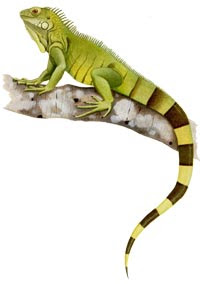
Green iguana

Imagem
Origin: Central and North America South. Size: 1.5 to 1.8 m in captivity. In nature they reach 2 m. Habits: diurnal and arboreal. He lives in the canopy of trees near the waterways. Terrarium: spacious (4 x 2 x 1.5 m) for an adult animal with rocks and logs. Humidity of 60 to 80% and temperature between 27 and 36 ºC.  Reproduction: ovípara, with posture of many eggs.  Handling: accepted well since accustomed since puppies. The Iguana is perhaps one of the highest expression reptiles in captivity, alongside the turtles. The body is strong, compressed laterally, being 2/3 corresponding to the length of the tail. The limbs are well developed and strong, with long fingers. It has a large rounded scale below the tympanum, a skin fold in the gular region (neck) and a crest at the top of the head, more developed characteristics in males. The coloration in the youngsters is intense green and with the passage of the years they appear dark bands along the body and the tail.  Feedin...

Angwantibo

Imagem
Common  Name : Angwantibo NAME IN ENGLISH: Common Angwantibo  SCIENTIFIC NAME: Arctocebus calabarensis  FILM: Chordata  CLASS: Mammalia  ORDER: Primates  FAMILY: Lorisidae  CHARACTERISTICS: Length: from 25 to 53 cm  Weight: 250g 4 legs of equal size opposable thumb, and small finger indicator. Walks in the trees and hunting at night Food: insects (mainly caterpillars) Not too light, and crazy for insects, the "angwantibo" specializes in hunting caterpillars. With his scrutiny, he can find them by smell. Some caterpillars are covered with stinging hairs, but the "angwantibo" does not mind this, since it takes off their skin before swallowing them. No sound is made other than snoring and squealing when scared. It clings to the branches of the trees with so much force that is very difficult to make it loose itself. This little primate without a tail is very sensitive to noise. He goes out at night, walking silently through the coves and forests of Ca...

Hyacinth macaw

Imagem
Popular name: Large Blue Macaw  Scientific name: Anodorhynchus hyacinthinus  Geographic distribution: North and Northeast of Brazil.  It lives in the forests of the interior of Brazil: Maranhão, Bahia, Mato Grosso, Minas Gerais and Goiás. Today it is rare to find it in freedom. But in the interior of Bahia, we can still find some specimens in freedom.  Habitat natural: Tropical forests.  Eating habits: It is omnivorous. It feeds on seeds and fruits. In captivity, it is common to eat peanuts, sunflowers, green corn and fruits.  Size: Up to 1.10 meter. It is the largest bird in the parrot family.  Weight: About 500 g  Period of gestation: The incubation period lasts 30 days. Number of pups: 2 pups are born at a time. They are fed by adults, who regurgitate food. They reach adulthood at 6 months.  Average life span: 30 years.  Conservation status of the species: This species is in extinction, mainly due to the destruction of its natural hab...